
What happens to the economy in a world where every consumer has a tireless and highly intelligent personal agent at their fingertips?
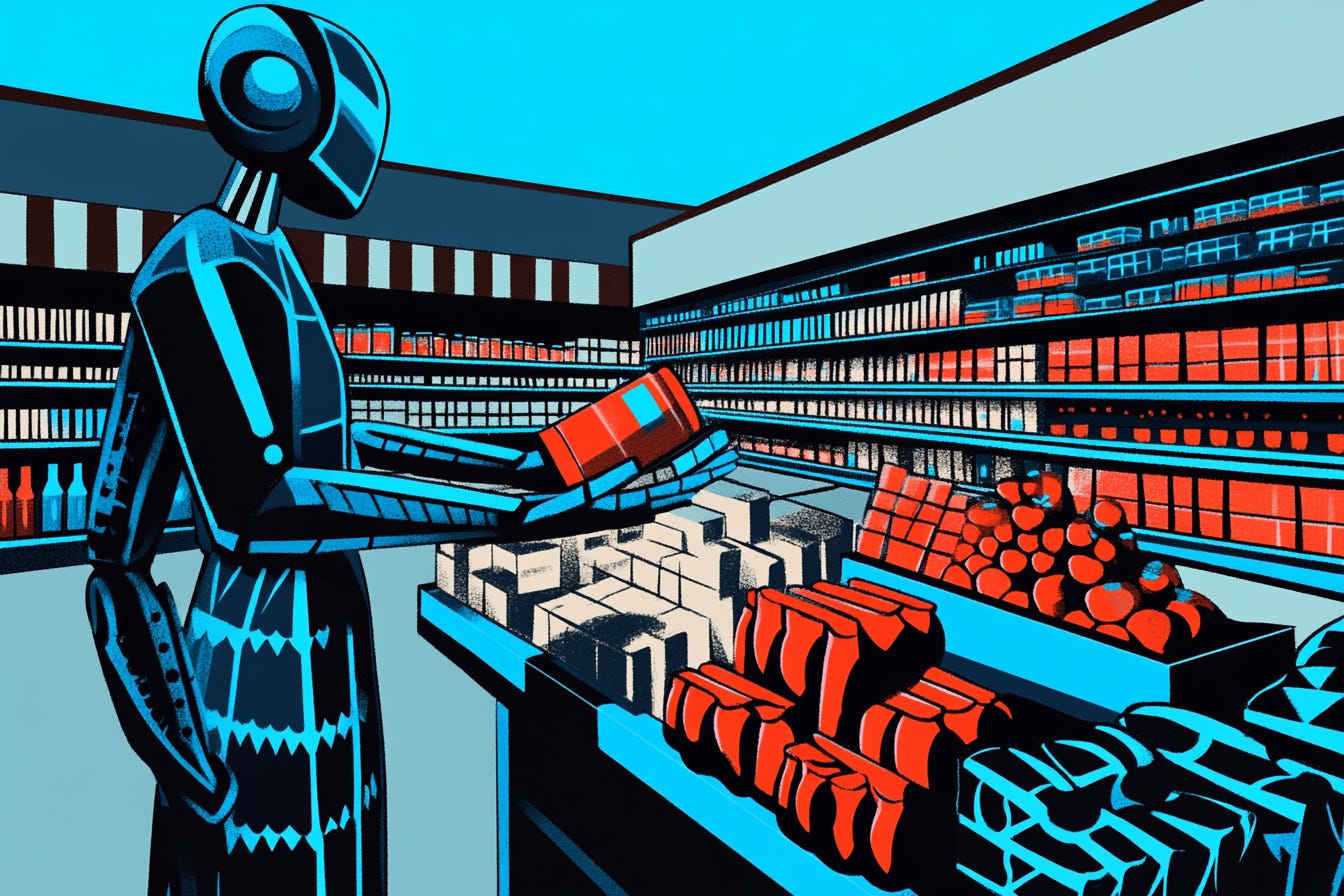
Personal agents are still mostly being used experimentally by tech enthusiasts. Many of these users are using agents built for software development, like Anthropic’s Claude Code and OpenAI’s Codex, by going beyond their original purpose, to more general tasks; some are already using purpose-built more general-purpose systems from these labs, like Claude Cowork; an even smaller group uses independent personal agents like Instinct, which went viral on X before its public launch (and recently announced a $250 million round at a $2.5 billion valuation - I bet they will need more capital soon, so wouldn't be surprised by a fast-following new round), or Poke and OpenClaw, which went viral a few months ago (the creator of the latter, which is an open-source project, having since joined OpenAI). Outside this circle of early adopters, most people are still using AIs like glorified search engines.
My bet is that personal-agent adoption will grow enormously over the next few years, until the overwhelming majority of people, the same group who uses smartphones today, have a personal agent handling a growing share of their everyday tasks. Bill Gates predicted this in 2023 by the way, when he said that within five years, “You won’t have to use different apps for different tasks. You’ll simply tell your device, in everyday language, what you want to do.”
Owning the relationship
Today, most companies want to own the relationship with their customers, especially when that relationship is recurring. Among other things, this means they want customers interacting directly with their physical and digital channels, e.g., stores and websites. Booking.com wants customers booking directly through it; Chase wants customers using its financial services through its website, app, or branches. Channels are an important part of owning the relationship.
There are a few reasons for this obsession. When customers interact with a company through its own channels, the company controls what customers see and thus can have much more influence over what they do. This also builds familiarity, encourages repeat purchases, and makes customers less likely to compare products and services with alternatives from competitors. Those customers become less sensitive to price and other terms, like delivery times; Cross-selling gets easier, too. A more perverse motivation is that owning the channel lets the company make buying easier while making actions like cancellations, renegotiations, and returns harder.
The first consequence of widespread personal-agent adoption is that the relationship between customer and company will become more distant, because it will be mediated by the agent. As Gates predicted, people won’t open their banking apps to send someone money. Let’s be honest: nobody wants to open the thing. They already use their personal agent for other tasks and will prefer to ask it to make the transfer. The agent, in turn, will execute the transaction through whatever means the bank allows.
Of course, these companies’ response, and we’re already seeing this happen, is to build their own agents, with the expectation that customers will simply say what they want in natural language instead of manually working through a series of steps in an app. This makes complete sense and is a much better experience than what was available until recently. And, frankly, the idea isn’t new. Bank of America has had Erica for years; Capital One has Eno. Generative AI gives this kind of assistant the ability to do more, and do it better, of what customers already expected from it. [1]
But this is a temporary equilibrium. Going back to Gates, customers won’t want to open a different app and talk to a different AI for most of their tasks. Water running downhill, fire racing uphill: good luck stopping either. So the more stable equilibrium will most likely be customers using an agent the company doesn’t control to interact with that company’s products and services. In this new arrangement, the businesses that know customers’ preferences best and influence which products and services reach them will increasingly be the personal-agent providers, with banks, travel-booking sites, and online retailers losing some of that influence. The customer relationship will still have a center of gravity, but it will be a different one. [2]
Betting on friction
The second consequence of widespread personal-agent adoption comes from agents being highly capable and, more importantly, tireless. Today, much of the relationship between consumers and companies is influenced by consumer inertia (a better(?) word would be laziness) and the difficulty of evaluating all the terms, nuances, and complexities of the products and services they buy. Economists put these difficulties under the umbrella of transaction costs. On the inertia side, most people don’t call their credit card company to ask for a retention offer, even when they suspect they could get one; the same goes, with slightly different tactics, for internet, cable, and cell-phone bills. When shopping for an auto loan, for example, few consumers manage to even make sense of all the different loan terms (such as fees and prepayment terms), who's going to say putting said terms on a common footing with alternatives so as to make a perfectly rational decision, comparing apples to apples. Finally, consumers tend to limit the number of companies they buy from to avoid having to use multiple apps, pay multiple bills, and so on.
Capable and tireless personal agents will change that reality radically. They won’t be too lazy to suffer through a call with a customer-service rep (something I personally consider one of the more horrible experiences a customer can be subjected to) to negotiate the best possible terms on the customer’s behalf. They won’t be too lazy to open accounts with multiple companies in pursuit of the best deal, for example using ten different credit cards depending on their rewards programs and terms, and handling all the hassle of paying ten different bills by their respective due dates. They won’t be too lazy to compare flights across dozens of websites, considering every possible combination of connections, the customer’s personal preferences, and other factors like accumulated miles. And they’ll do all of it proactively, without the customer having to even ask.
As a result, customers’ relationships with companies will become more intentional and, in some respects, much more objective. Even if consumers have a subjective preference for a particular company, it will become harder to let that preference carry them away when their personal agent clearly shows them they're getting a bad deal. In categories like credit cards, flights, internet service, auto loans, and many others where the characteristics of products and services are easier to compare, this objectivity will probably be much greater. This will naturally make competition fiercer and more focused on those objective characteristics, especially price. In others, like fashion, restaurants, luxury goods, education, and professional services, the effect will also exist, but it will be less pronounced. [3]
Competition will also change in speed. Consumer inertia currently acts as a kind of shock absorber: even when a company raises prices or worsens its terms, customers take time to notice and react. With personal agents continuously monitoring those conditions, changes that once took months could happen in hours. An internet provider that raises its prices could almost immediately receive thousands of automated requests for renegotiation or cancellation. [4]
Game theory
Finally, it will be interesting to watch how companies behave through the lens of game theory. At first, the default response will probably be to make it difficult, or even impossible, for personal agents to access their interfaces. But the first company to break that equilibrium and roll out the red carpet for agents will push most of the others to do the same: by making agents’ lives easier (which could mean opening up APIs and MCP servers, or even creating agents whose specialty is dealing with customers’ agents), that company will be considered for more transactions, forcing competitors to choose between doing the same and losing sales. A few will stay in denial, hoping the world goes back to the good old days. But the good old days of lazy customers are definitely numbered.
[1] Bank of America launched Erica in 2018; Capital One introduced Eno in 2017. Companies have wanted customers to talk to their software for a long time. More capable AI should make those conversations much more useful. Whether I want to have a separate conversation with every company’s software is another matter.
[2] I’m still willing to bet that, for most regular people, like my mom, the default agent will come bundled with their phone or operating system: Apple because iOS, Google because Android, Microsoft because Windows. Distribution matters enormously here. A standalone agent will have to give people a compelling reason to go find it and use it instead of whatever is already sitting on their devices.
[3] This assumes the agent is actually working in my interest. If its recommendations depend on which merchant pays its provider the most, the argument about more objective purchasing gets considerably weaker. Being independent of the merchant doesn’t automatically make an agent aligned with the customer. Owning the agent could become a very profitable way to influence the customer all over again. Who pays for these things, and how, will matter a lot.
[4] Some of this should carry over to B2B as well. Companies already pay people to compare suppliers and negotiate contracts, so the starting point is different. But those people also have limited time and a backlog of things they haven’t gotten around to. They’ll use agents, too, and some purchases that are too small to justify a procurement exercise today may become worth checking routinely.